
Should You Wear a Belt With a Suit?
You should wear a belt with a suit only if your suit trousers have belt loops. If they have loops, a belt finishes the look. If they do not, the trousers were never designed to take one, and adding a belt is the wrong call.
It sounds simple, and it is, but this is one of the most common questions in men’s fashion, and the advice online genuinely conflicts. Classic tailoring treats a suit as a beltless garment. Modern practice treats a belt as completely normal. Both camps agree on the loops, which is why the loops are the only test you need.
Here is when to wear a belt, when to skip it, and how to choose the right belt once you have decided.
When You Should Wear a Belt With a Suit
There are three clear cases where a belt is the right answer.
Your Suit Trousers Have Belt Loops
This is the main one. Most off-the-rack suit trousers and most dress pants come with belt loops as standard, and if yours do, wear a belt.
Beyond appearance, a belt keeps the trousers anchored through the day and stops them from dropping at the waist. That matters most once the jacket comes off, because the waistband is suddenly doing the work on its own with nothing covering it.
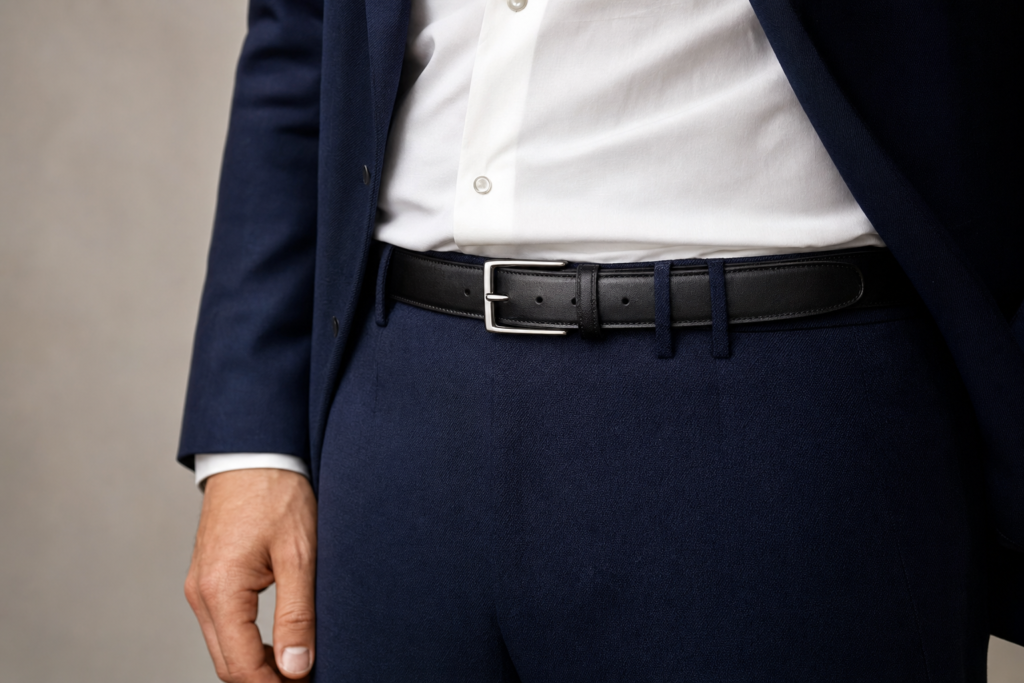
Worn properly, the belt should fasten on the middle hole with the tail tucked through the first loop. If you are buckling on the last hole at either end, the belt is the wrong size rather than the trousers being the wrong fit.
You Want a Visual Break in the Outfit
A belt adds a visual break across the middle of an outfit, and that is genuinely useful when your shirt, trousers and jacket all sit in similar tones. In a monochromatic look, the eye runs straight through the middle with nothing to stop it.
A belt breaks that line, defines the waist and gives the outfit some structure. It is a small piece of hardware doing a surprising amount of work.
Business and Everyday Suiting
For the office, meetings, job interviews and everyday formal wear that stops short of black tie, a dress belt is standard and expected. Nobody will look twice, and skipping it is more likely to be noticed than wearing one.
This is the ground where classic tailoring and modern practice agree, so there is no risk either way. If you are choosing a suit you will wear weekly rather than once a year, assume a belt is part of the outfit and buy with that in mind.
When to Skip the Belt
There are four situations where the belt comes off, and this is where most men get it wrong.
Trousers With Side Adjusters or Side Tabs
Side adjusters, sometimes called side tabs, are small buckles or fabric tabs at each hip that let you tighten or loosen the waist by a couple of centimetres.
They are common on higher-end, made-to-measure and tailored suit trousers, and they usually replace belt loops entirely. If your trousers have them, they are the intended way to adjust the fit to your own measurements. A belt is neither needed nor possible.
Using them is simple. Adjust both sides evenly so the waistband sits level, and aim for a fit that holds without pinching when you sit down. Done well, side adjusters give you a cleaner waist than a belt ever will, because there is no hardware sitting at the front of the trousers.
Tuxedos and Black Tie
Most tux pants do not have belt loops at all, and that is deliberate rather than an oversight. Traditional formal trousers are designed to be held by braces.
A belt under a cummerbund or waistcoat also creates bulk in exactly the place you want the line to stay clean. For black tie and the most formal occasions, the answer is side adjusters or suspenders, never a belt.
If you are wearing braces with a tuxedo, choose button-on braces rather than clip-on, and keep them plain black or white.
They sit under the waistcoat or cummerbund, and nobody should ever see them. If black tie is on the invitation, a proper tuxedo is cut with all of this in mind.
Three Piece Suits and Waistcoats
With a vest, classic style says go beltless. A belt buckle pressing through the front of a waistcoat creates a visible lump right at the centre of the outfit.
It is a small detail, but it quietly undoes the clean line that a three-piece suit is meant to deliver. If the trousers have loops and you still want the security, braces solve the problem without the bulk. What you should never do is wear braces and a belt at the same time.
A Properly Tailored Suit
This is the classic tailoring position, and it is worth understanding even if you do not follow it. A good suit is cut to precise measurements, and a perfectly fitted waistband should hold on its own without anything helping it.
Worth being honest here. This is a style view rather than a hard rule, and it only holds if the trousers genuinely fit. If your waistband needs a belt to stay up, the answer is a tailor, not a tighter belt.
There is a practical test. Put the trousers on without a belt and walk around for a minute. If they stay where you put them, the belt is decoration, and you can treat it as optional.
If they slide, get the waist taken in and the problem disappears for good.
How to Choose the Right Belt for a Suit
Once you have established that a belt belongs, three things decide whether it looks right.
Match Your Belt to Your Shoes
This is the single most important rule and the one most commonly broken. A black belt goes with black shoes. A brown leather belt goes with brown shoes.
Our guide to what shoes to wear with a suit is the place to start, because the shoes come first and the belt follows.
Match the finish as well as the colour. A high-shine belt against matte leather still reads as a mismatch, even when the colours are close. Your belt buckle should coordinate with your other accessories too, so keep the metals consistent across your buckle, watch and cufflinks.
Less common shoe colours need a little more thought. Tan, oxblood and burgundy shoes all want a belt in the same family rather than a generic brown, and suede shoes are best paired with a suede or matte finish belt so the textures agree.
Start from your shoes and work backwards, because they set the colour for everything else.
Width and Buckle
A formal belt should be slim. Around 3 to 3.5 cm is the standard dress width, and it sits correctly in suit trouser loops without straining them.
Anything noticeably thicker reads as casual and looks out of place against tailoring. Very skinny belts go the other way and look fussy. The belt buckle itself should be small, plain and understated. Bold buckles, heavy hardware and visible logos belong on a casual outfit, not with a suit.
Length matters as much as width. As a rule, buy a belt around five centimetres larger than your actual waist measurement rather than your trouser size, which is often quoted differently. A frame or pin buckle is the safest choice for a suit, and a plate buckle is best left for casual wear.
Leather and Materials to Avoid
Smooth full-grain leather is the standard for a dress belt. It holds its shape, it ages well, and it looks right against suiting fabric.
Avoid canvas, webbing, braided leather and heavily textured material. Those belong with casual pants and jeans, and they undercut a suit immediately no matter how good the suit itself is. A reversible belt is useful for travel, but one good belt in black and one in brown will serve you far better over time.
It is worth seeing what sits in the accessories range before you commit to one.
Belt Mistakes to Avoid With a Suit
A handful of errors show up again and again, and all of them are easy to avoid.
They sit alongside the other common mistakes to avoid when wearing a suit and are just as quick to fix.
Wearing a Belt and Braces Together
Pick one. Both at once is the clearest sign that neither was a deliberate choice.
Choosing a Casual Belt
Canvas, chunky buckles and distressed leather pull a formal outfit straight down, however good the suit is.
Not Matching Your Shoes
Your belt and shoes speak to each other before anything else in the outfit does, and a mismatch is the first thing people notice.
Leaving Empty Belt Loops
If the loops are there, use them. An empty loop looks like an oversight rather than a choice.
A Long Tail Hanging Loose
If more than a few centimetres of belt hangs past the first loop, the belt is too long. It should stick close to the waistband rather than flap.
Threading the Belt the Wrong Way
A belt should run left to right as you look down, with the tail finishing on your left hip. It is a small thing, but it is noticeable once you know to look.
An Oversized Buckle on High-Waisted Trousers
High-waisted trousers already draw the eye to the middle of the body. A large buckle there becomes the entire outfit.
Still Unsure about Wearing a Belt with a Suit? Contact Penguins Formal Wear Today!
When in doubt, look at the loops. They tell you what the trousers were designed for, and that answers the question nine times out of ten.
From there it is simple: match the belt to your shoes, keep it slim and plain, and never pair it with braces.
If you are shopping for a suit, a tuxedo or the accessories that go with them, it helps to see how the pieces work together in person.
Get in touch with Penguins Formal Wear today, and our team will make sure the details are right before the day arrives.